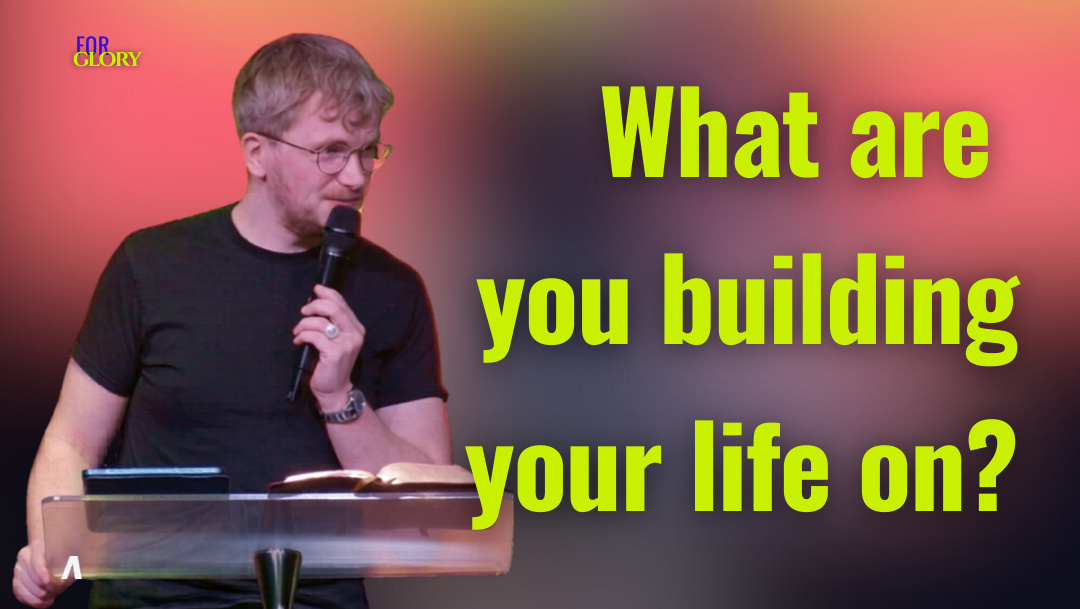
Walking With Jesus in the In-Between
I’ve been thinking a lot about this part of church history, really the very beginning of the church. It’s a strange period of time that we read about in Scripture.
When the disciples were walking with Jesus—when Jesus was physically on the earth before His death, burial and resurrection—they were always moving somewhere. There was always somewhere to go. They were going from one town to the next town, one place to the next place. If you’ve read the Gospels—Matthew, Mark, Luke and John—you get this strong sense of journey. There is always something to do, somewhere to go, another place to be.
And every time and every place they found themselves with Jesus, there was another miracle to witness. They would see Jesus do something incredible, teach something incredible. They would see something incredible of God in those places. Walking with Jesus almost paints a map of miracles, a map of miracles and wonders.
I just imagine these disciples going through the Middle East, leaving miracles in their wake. In fact, I’ve even got a map. You can see the Sermon on the Mount, you can see the raising of the dead, the resurrection appearances—it’s like the whole landscape is dotted with moments where heaven breaks in. This is what it’s like to walk with Jesus: just walking around the land, and the map of the journey is marked by miracles.
And then Jesus dies. We have the crucifixion. But even after the crucifixion of our Lord, the miracles continue.
At the tomb we see the miracle of the resurrection in John 20. We see another miracle in Cleopas’ house, which I spoke about a few weeks ago, when Jesus revealed who He was through the breaking of bread. There we see revelation.
We see the confirmation to Thomas at the disciples’ house in John 20. We see Jesus provide a bountiful catch of fish in John 21 when they’re on the Sea of Galilee, a miracle of provision. Just after that, we see Jesus on the seashore speaking to Peter, and we see this confirmation of the Church of Christ and what it’s going to be built upon—there we see identity and calling.
Then in Acts 1 we see the exhortation, when Jesus is lifted up and ascends into heaven. So even in this period there is still movement, a continuation of movement and of miracles.
But I find it really interesting that the period between the crucifixion of Christ and this passage we’ve just read in Acts 2 is a very strange time, because the disciples are not led in the same way in this time. While Jesus was on earth, they were led by—this is not a trick question—Jesus. He was physically with them, leading them.
And then, beyond that, they will be led again, which we’ll come onto. But in this in‑between period, they are not directly led by Him in the same way. They keep seeing Jesus at different times, in different places, doing different things, but they’re not being directly led step by step. They’re kind of on their own for a little bit, and yet they’re still going from place to place: from the tomb, to the house, to Galilee, to another house. There’s still movement.
In fact, they’re sometimes even prompted to move on, which I find really interesting. At the tomb, when they first witness the resurrection of Christ, an angel of the Lord appears to them and says, “Why do you look for the living among the dead?” In other words, there is nothing more to see here. The miracle here has happened. It’s time now to move on.
A little while later, at the ascension of Christ, when Jesus is taken up to heaven, it’s time for Jesus to go now—and so He does. Can you imagine what that must have been like? You’re standing in front of Jesus, having a conversation with Him, and then He says, “It’s time for Me to go now,” and He rises into heaven. How incredible must that be?
So the disciples are just standing there, looking up into heaven where they’ve just seen their Lord and Teacher ascend, just staring. I think that’s exactly what we would do. What is this? Because that is strange. Has anyone ever seen someone just ascend into heaven? No. It’s a weird thing.
So they’re just left standing there, and again an angel appears to them and says, “Why do you stand here looking into the sky?” The miracle has happened. Now it is time to move on.
It occurs to me that this constant movement of the disciples throughout the land—both with Jesus and after He ascends—shows us that these miracles occur in specific times, in specific places. And the disciples are encouraged to move on after the miracle.
Because we cannot stay in the place of yesterday’s miracle. That miracle was for yesterday. There is a new miracle for today. That’s what we see in this journey of miracles: there was a miracle for yesterday, but it’s time to move on, because there’s another miracle for today. But we can’t stay in the same place.
There is always something else to see, something to experience, something to do. We can’t wait for God to do the same thing He did in the last season, in this season. And even more so, we can’t wait for God to do someone else’s miracle, the miracle He did in their season, in our season.
From Past Wonders to Future Calling
Has anyone ever heard someone's testimony, someone's story? Yeah?
Here's another question you might not want to answer: has anyone ever heard someone's testimony or story—something incredible that God has done—and then felt jealous? Some people are like, “Yeah,” and that’s okay. I know I have. I’ve heard what God has done in someone’s life, or in a church somewhere else, and I’ve thought, “Man, why hasn’t God done that in our situation? Why hasn’t God done that in our church?”
Particularly when you go to the AOG conference and you hear from these leaders who are leading other churches in other parts of the country, and they’re telling these incredible stories. Sometimes I have to catch myself because I’m thinking, “Why doesn’t God do that in our place?”
And the answer is this, Church: God has got miracles for us in our church, and God has got miracles for them in their church. They are not the same miracles. We can’t waste time coveting the miracles that are for somewhere else just because they’re not happening here. God has plans and purposes for the people in this church, right here.
I find it difficult to keep thinking along that road. It takes discipline, doesn’t it? It takes discipline to not covet someone else’s miracles. On a more personal level, you might hear a story of deliverance or of what God has done in someone’s life and you’re like, “Lord, why can’t that be in my life? Why can’t that be my story?” That can be painful, can’t it? It can be painful to see someone else receive a healing or a deliverance or something significant, and yet you’re still struggling with that very thing. That’s real, isn’t it?
I want to encourage you this morning that God is not out of miracles. The journey we’re on is a journey that is littered with miracles, as that map shows. When we walk with Jesus, we walk along a journey of miracles. But we can’t hold on to the miracle that was for yesterday.
As we move into this new season of ours at Assemble Church, with new buildings—well, there’s this new building—I just want to say that the new building is really exciting, but the Lord is already speaking to this church about what is next. I don’t want to scare you, but I need to tell you that this building is not the end. This is not, “Oh, we’ve done it. Now there’s a building. Happy days. Let’s enjoy that forever.” Hopefully we will enjoy it for a long time, but not only that—because there is more.
God is already speaking about what is next, what is beyond this, because God has things for us to do. It’s really exciting. It’s terrifying, but it’s exciting. The Lord is building His church; the gates of hell will not prevail. And the Lord uses men and women of God who are committed to Him, who operate diligently in His ways and are obedient to Him, to further His kingdom.
Church, I want to tell you that we are a church filled with people who are obedient to God, and the Lord is moving through this church. So it cannot possibly be that this building we’re about to walk into is the end. There is far more for us to do. I’m excited. The Lord is speaking to us about what is next.
So, miracles. We can’t hold on to the miracle of yesterday. There is always movement. There is always something that God is leading us into next—the next thing that God has for us, the next thing He has for us to witness or to experience.
Now, that isn’t to say that we should just move on quickly, as though we should forget about what God has done. We mustn’t move on without recording what God has done in our hearts. Many of you might have heard me speak about this before: the importance of remembering the miracle, remembering the move of God, what God has done. Write it down somewhere. On our hearts, record it. Cherish it, so that we remember the goodness of God.
That’s really important for our discipleship journeys—to remember the goodness of God. Because who knows—and if you don’t know this, let me tell you now—you will encounter future battles. You will encounter future adversity. There will be things that you come up against that will rock you and shake you. I don’t want to discourage you this morning, I’m just telling you the truth. Is that okay?
These times will come, because the Lord said that you will face many troubles. And James says, “Consider it pure joy when you face trials of many kinds.” We will face these things. So it is important for us to remember and to recount and to recall, to write on our hearts what God has done, so that when we face those things we can look back and say, “I have a God who is faithful. I have a God who is all-powerful.”
We can do that in all sorts of ways. I want to encourage you to do that—perhaps a prayer journal, or a diary, or a calendar entry, or photographs, or something of that nature. I really want to encourage you to record what God has done. As we’re on a journey of miracles, we need to remember them for the journey ahead. Does that make sense?
Remembering the Miracles of God
Can I share with you one of my own stories that’s come up recently?
We can record the miracles of God in whatever way works best for us. As I’ve said, a prayer journal is one way—writing down the prayers we bring to the Lord and then coming back to see what God has done.
I want to share this picture of me and Soph from a recent holiday. The reason I want to share it is because, for us, it records a blessing of the Lord. In fact, it records a miracle of the Lord. For those of you who know some of our story, you’ll know that this photo encapsulates a miracle and a blessing from God.
So when I look at this picture, it’s not just, “Oh, look, that was a nice time we had once.” When I look at it, I say, “Wow, God. Thank you, Lord. Thank you, Lord, for the miracles and the blessings that you bestow upon us. Thank you, Jesus.”
We can record the miracles in our hearts in different ways. So I want to encourage you, as you move through your own journey of miracles, to write things down, to take photos, to find ways to record what God has done in your life—the moves and the miracles of God. Is that all right?
Meeting God on the Journey
I speak about this a lot, because there’s actually a biblical precedent for it in the Old Testament. Many times, altars are established—altars are built—to recall what God has done.
Let me bring your attention to Genesis 28, where Jacob is on a journey. He’s going from A to B, and along the way he stops for the night and goes to sleep. In that sleep, he has a dream where he encounters God. In the dream he sees God, he encounters God, and the Lord says to him, “I am the Lord your God.” This is a real encounter that Jacob has with God in that place.
Then in verse 18 it says that when Jacob woke up, he called that place Bethel. He poured oil on a rock and made a bit of an altar there, recalling and remembering what had happened. He says, in essence, “This place is called Bethel—house of the Lord—because this is where I encountered God.”
But then Genesis 29 says this: “Then Jacob continued on his journey.”
So he encountered God. He encountered the Spirit of God, the move of God, in that dream where the Lord spoke to him and revealed Himself to him. He remembered it by building an altar and saying, “This is where I met God. I will not forget it.” But then he moved on. He experienced it, recorded it, and moved on from it.
That’s the journey we’re on. Amen? Is that good, Church?
Beyond the Epicenter of Miracles
After the crucifixion of Christ, we’re still in Acts here, still just before the pouring out of the Holy Spirit at Pentecost. This is what the disciples did in that in‑between time: they experienced miracle after miracle. The tomb, the house, the Sea of Galilee – they were still encountering Jesus, still seeing what God was doing, witnessing miracle after miracle.
Perhaps they were almost desperate not to miss the next thing, hoping not to miss the next encounter with Jesus. They were no longer being led directly, day by day, by Jesus in the flesh. Instead, they were trying to work out where to be and when, just guessing where the next thing might happen, hoping to be in the right place at the right time. And sometimes, as I’ve said, they were even told by an angel of the Lord, “It’s time to move on now, because the miracle in this place has happened. There’s something else to see.”
I imagine this was an exciting time, don’t you? Not knowing what was coming next. But I also imagine it was exhausting. Exhausting to try and keep up with what was going on.
And did you know that most of the disciples missed the empty tomb? Initially, most of them weren’t there. It was discovered by the women first, and then only a few of the disciples went back to see it. Most of them missed that moment. Thomas missed the first time that Jesus appeared to the disciples. We call him “Doubting Thomas” now – we’ve preached on that several times – but he simply wasn’t in the room when Jesus came, and at first he didn’t even believe the others’ report. He wanted to see the evidence for himself.
So this is an exciting time, but it’s also an exhausting time. Lots of things are happening, but there are also things that people are missing. When I read this part of Scripture, it feels like these followers of Christ are chasing the miracle – trying to keep up, trying to stay at the epicentre of what God is doing, trying to be where God was, and then trying to be where God is next. Waiting for the same thing to happen again. Waiting to experience the move of God, and just trying to be in the right place at the right time. That’s what comes off the page to me, and it feels like it must have been exhausting to be part of.
Because we are supposed to witness miracles. Did you know that, church? We are supposed to witness miracles. The Lord said, speaking of the things He had done, that those who believe in Him would do even greater things.
“Very truly I tell you, whoever believes in me will do the works I have been doing, and they will do even greater things than these.”
Who is He talking about? He’s talking about us. He’s talking about us, church.
Just think about what that means, in reference to the works Jesus did. What has Jesus been doing? Healing the sick, raising people from the dead, opening blind eyes, casting out demons. “Whoever believes in me… will do even greater things than these.” That’s what the Bible says. We are supposed to be on this journey of miracles.
But Jesus has a better plan for us than for us to be constantly chasing the epicentre of the miracles. Before He ascended into heaven, He said to His disciples, “Wait. Don’t go yet.” Because while there is so much to see and so much to do, and there will be greater things even than what they had already seen, Jesus said, “You can’t do it alone. You can’t do it alone.”
The Spirit-Empowered Church in Acts
And so we get to our scripture today, Acts 2:1–4, where the Holy Spirit is poured out on the church. From this moment, the dynamic of the miracles shifts completely. There is a complete change in how things now work.
They go from chasing the miracle and just hoping to be in the right place at the right time, to each individually being the epicentre of the miracle. Each person becomes the epicentre of the miracle.
In Acts 2, Peter addresses the crowd and he speaks through the Spirit with so much eloquence and confidence that he just never had before. Why? Because he’s speaking in the Spirit. In Acts 3, Peter heals a lame beggar, just like Jesus had done many times. In Acts 5, it says the apostles healed many people. In Acts 12, Peter is miraculously able to escape from prison through the power of prayer and God’s intercession in that.
And then from Acts 15 onwards, Paul’s countless missionary journeys, deliverances, transformations—everything that he is able to see and preach and bring about is because of the power of the Spirit of God. These people, they’re still moving, aren’t they? They’re still on a journey. They’re still going somewhere. They’re not staying still. There is always something to do, always somewhere to go.
Because even for Paul, even for the apostle Paul, the miracle that is for Corinth is not found in Ephesus, is it? And the move of God that is in Malta is not found in Rome. And so there is always movement. There is always something to do. But it’s different now. No longer chasing, no longer searching—now guided by the Spirit.
They are the epicentre of the miracle. As they move, the Spirit of God becomes evident, and the work of the Spirit of God becomes evident wherever they go. New wonders for new days. This is an incredible story; I’d encourage you to read it.
It’s no longer about being in the right place at the right time, because now the right time is now, and the right place is wherever you are.
The Church as Epicenter of Miracles
Calling on the name of the Lord and trusting in being led by the Spirit of God, we become the epicenter of the miracle. Now, I need to be careful and put a little disclaimer in here. I’m not saying that you are all-powerful. I’m not saying that you are God. I’m not saying any of that weird stuff, because actually it’s got nothing to do with you, but it has everything to do with Him who is in you. Amen?
Is the Spirit of God alive and active in you? That is the epicenter of the miracle—not you individually. Sorry about that, but that’s the truth. As carriers of the Spirit and the presence of God, we become the epicenter of the miracle.
We need to know that there are many, many more things to see, many more things to witness, many more things to be a part of. But we also need to know that they are not where we currently are; they are where we are going.
Who knows, church, that there are more healings? Who knows that there is more of the healing work of the Spirit of God to be done—healings of people’s minds, healings of people’s bodies? There are healings yet to take place.
Who knows, church, that there is more miraculous provision to come? That there is more that God wants to pour out in provision—in ability, in skill, in resources, in whatever it might be? There is more to be poured out.
Who knows that there is more life transformation to happen? Who knows that there is more that God wants to do to transform the lives of individuals? Who knows that there are more blind eyes to open? Did you know there are more ears to hear? Did you know that there are more chains to break?
Who knows someone in chains? Who knows someone bound by addiction? Who knows someone bound by patterns of behavior or recurring challenges? Who knows that there are more chains to break? And who knows that there are more souls that will be saved, that there are yet more to be added to the kingdom of heaven? Thank you, Lord Jesus.
Jesus gave us this mission as the church. He told us to go into all the world, to make disciples, and to baptize in the name of the Father and of the Son and of the Holy Spirit. This is the mission that He has bestowed upon us, that He has entrusted to us. The church of Jesus Christ holds this mission. It is our duty to do that.
As we accept Jesus Christ as our Lord and Savior, as we are given entrance into heaven, so He has bestowed upon us a duty to further that kingdom. But it’s not for us to do alone. He said, “Wait to receive the Holy Spirit,” because what we have to do cannot be done alone. Did you know that?
If we are doing it alone, we’re not doing it right. We’re not doing it in the power of God, which means we’re not really doing it. If we’re just doing something in our own strength, it means we’re not seeing what God can truly do; we’re just solving things on a human level. And yes, sometimes we can solve things on a human level, but God wants to break through and do what only He can do.
So as well as being entrusted with the mission, He entrusts us with the means. Thank you, Lord. Amen.
Preparing Our Hearts for Pentecost
We’ve got a lot to do, and I’m so excited. Did you know that in the next season of where we are as a church—new buildings and beyond that, into all that God has for us—there are so many miracles we are going to see? We’re going to see the Lord move in ways you’ve never seen before. We are going to witness things that are just going to blow our minds.
We often hear stories of revivals of old: the Toronto Blessing, the Welsh Revival, all these things. Have you heard of those? “Yeah, I’ve heard of those, but I didn’t experience those.” Instead, I know that the Lord has something else for us to experience—something that’s for our time, for our generation—because the Spirit of the Lord is still poured out on us. Amen? The Spirit of the Lord is still operating, and the mission of the Kingdom of God is still just as important as it ever was. And what we are going to see is going to be incredible.
Next week is Pentecost, and we’re going to hear from the Spirit. We’re going to hear what God is speaking to His church, through His church, and I’m really excited about that. But what I want us to do ahead of that is to begin to prepare ourselves for it.
As a preacher, as someone who is preaching the Word of God, I read the Scripture and I ask the Lord, “Lord, what is it that You want to say to Your church this week, in this season? What is the important thing to communicate here?” So I’m reading Acts, and I’m getting this idea, this picture of journey—the Lord leading people through a journey, a map of miracles. It’s all very exciting. There’s this idea of constantly moving on and all that kind of stuff. And then I’m thinking, “Okay, cool, the Holy Spirit is poured out. How did that happen? When did that happen? Why don’t we try to do what the Scripture did?”
I wanted to bring a point. That was my point. It wasn’t a point from the Lord, which is always a really dangerous place to be. I wanted to say, “Look, we’re going to pray that the Holy Spirit would come and fill us afresh,” and I wanted to make this point about being gathered together and praying. But then I realised: the Scripture doesn’t really say that. That’s a really dangerous place to be.
But actually, I find it’s better than that—who’d have thought? In Acts 1:14, the Scripture says that they all joined together constantly in prayer. But that’s not when the Spirit of God was poured out. The Spirit of God was poured out an undisclosed amount of time later—certainly not the same day—on the Day of Pentecost in Acts 2. And all it says there is, “When the day of Pentecost came, they were all together in one place.” No prayer mentioned. So the prayer happened before, in Acts 1, and then a little while later, when they were gathered together, is when the Spirit was poured out.
I wanted that all to be in one passage so that it was nice and succinct. That’s what I wanted. The Lord didn’t want that.
So here’s what we’re going to do. We’re going to pray, because it says they all joined constantly in prayer. We’re going to pray today, and then we’re going to pray all week, so that next week we will come prepared and expectant, on the Day of Pentecost, to encounter God in a way we have not encountered Him before. For some of us, to receive the Holy Spirit for the first time; for others, to be filled afresh with the Holy Spirit; to hear from Him. I’m excited about that.
As I say, the Scripture has this way of sometimes slowing us down. So today we pray. All week we pray. Next week we gather together. Is that good?
I’d like to invite you to stand as we pray.
Preparing the Heart for Threefold Challenge
We’re going to pray in preparation. I want to lead us to prepare our hearts for three different types of challenge this morning, or three different places we might find ourselves.
The first is if you’re here this morning and you’re waiting to experience a miracle or a move of God that actually belonged to a previous season—something you experienced in the past, in a previous ministry, a previous time, a previous context—and you’re pining for that to happen again. “Oh, but Lord, I saw this and it was great, and the church grew… Why can’t we just do that again? Why can’t we recreate the conditions that caused that to happen?” I want to encourage you, but also challenge you: that has happened. That’s yesterday’s miracle. And yesterday’s miracle is not for today. There is a new miracle for today. There is a new season for today.
The second person I want to speak to is someone who is perhaps coveting someone else’s miracle. You’ve seen and observed a miraculous move of God for a different person, in a different season, in a different church perhaps. You see what God has done in someone else’s situation, and your heart is maybe coveting that. And coveting is a strong word, I accept that, but perhaps that’s what’s going on. I want to encourage you and challenge you: moves of God are unique in circumstance. Someone else’s miracle isn’t for you. You have your own miracle. You can be encouraged by what God is doing in someone else’s life—and that’s awesome—but the miracle that God has for you is personal.
And then the third group of people is those who feel like you’re always chasing the miracle, always trying to seek out where it will happen next, rather than being the epicentre of it, rather than ushering it in. God poured out His Spirit on the Church so that we would no longer be chasing miracles, but that we would be causing them—not by our own strength, not by our own power, might, or ability, but by His.
So we’re going to pray.
Preparing Pentecostal Families for the Holy Spirit
Lord God, we thank you, Jesus, for your Church. Thank you for your Holy Spirit. Thank you that you pour yourself out on us, that we are called to mission, and that we're called to witness and experience miracles. And that we are called, Father, to do that by your Spirit operating in us and through us.
So, Lord, would you help us? Would you help us today and would you help us this week to be a people who begin to recognize more of what it is that you're doing? To recognize more of the miracles that you want to pour out, that you want us to see, to witness, and to experience?
I pray for those of us who are waiting to experience a miracle or a movement that was for a previous season. Lord, would you help us to release that? Would you help us to let go of that? Would you help us to see what it is that you have for this day, for this season? Would you help us to usher in what you have for our time, our place, our generation, for now?
Lord, for those of us who are perhaps coveting someone else’s miracle—a miracle in a different church, a different person, a different situation, a different circumstance, something that we see and want to happen for us—would you help us to have grace in that? Would you help us to release that? Would you heal us from that? And would you help us to heal from that?
This is not an easy thing when we’re so desperate for a miracle that we’ve seen someone else receive. But Lord, would you heal our hearts? Would you bring us peace in those situations and circumstances? Would you bring us a sense of fullness and wholeness, of being content in who you are? Would you help us to be encouraged by what you’re doing in other people’s lives, and not jealous? Thank you, Lord.
And for those of us who feel like we’re always chasing the miracle, always looking for where it’s going to be next rather than being the epicentre of it, would you help us to acknowledge your Spirit within us—that it is your intention to operate through your Spirit in us?
All these incredible stories that we read in Acts and beyond, these incredible stories of deliverance, of healing, of chains breaking, eyes opened, ears hearing—Lord, would you do something in our spirit that reminds us, not just in our heads but deep in our spirit, that it is your intention for that to operate through us? That is why you poured your Spirit out on us.
So as we go about our week, Lord, your Scripture says that ahead of that first Pentecost Sunday, they all joined together in prayer. And we are joined here together this morning, Lord, in prayer. Would you help us this week to continue to prepare our hearts, to prepare our spirits to hear from you and to receive from you? Next week, would you help us to come prepared and to come expectant?
Thank you, Lord.
Amen. Amen.